Submission Painting

Entity

The initial question of this work was when Aristotle's logic re-entered Western thought after antiquity - and how the world was perceived before then.
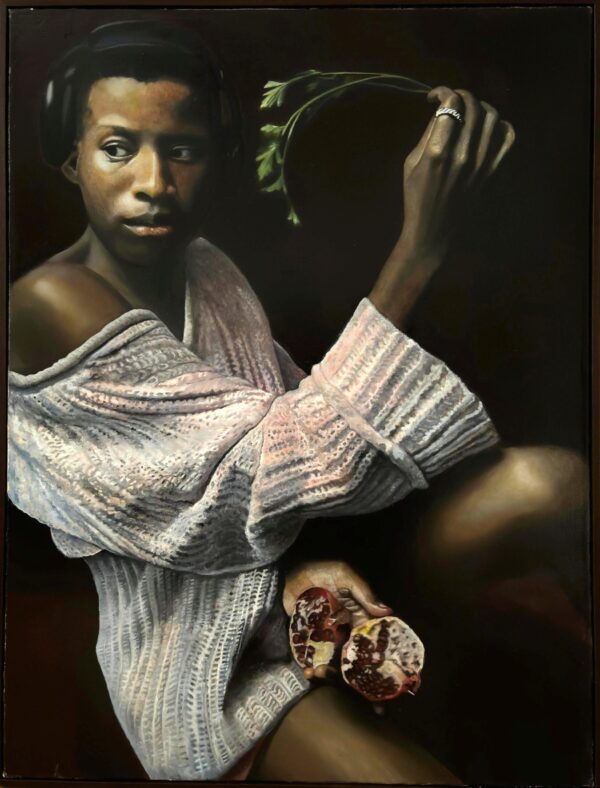
The artist takes up this question and answers it in allegorical form with an image that refers to the Roman god Janus. Janus, as the guardian of the threshold between the beginning and the end, is depicted here symbolically - in a pose reminiscent of John the Baptist in a painting by Caravaggio.
Instead of the typical key, an attribute of Janus, the figure is holding a sprig of parsley. The shape of the leaf is reminiscent of the shape of a key. The two open halves of the pomegranate in the picture emphasize the duality of beginning and end, inside and outside.
John's pose in Caravaggio's work only becomes fully apparent when you try to recreate it yourself. It can hardly be held


Learn more here

Entity

The initial question of this work was when Aristotle’s logic re-entered Western thought after antiquity – and how the world was perceived before then.
The artist takes up this question and answers it in allegorical form with an image that refers to the Roman god Janus. Janus, as the guardian of the threshold between the beginning and the end, is depicted here symbolically – in a pose reminiscent of John the Baptist in a painting by Caravaggio.
Instead of the typical key, an attribute of Janus, the figure is holding a sprig of parsley. The shape of the leaf is reminiscent of the shape of a key. The two open halves of the pomegranate in the picture emphasize the duality of beginning and end, inside and outside.
John’s pose in Caravaggio’s work only becomes fully apparent when you try to recreate it yourself. It can hardly be held